You might have started seeing the term Consumer Data Right, or CDR, pop up more often when using banks, financial apps and other online services.
But what exactly is it? And what does it mean for your data?
Put simply, the Consumer Data Right is an Australian Government-regulated framework that gives you greater choice and control over how your data is shared and used.
Rather than your information staying with the organisation that holds it, CDR allows you to choose to securely share eligible data with another participating provider to access a product or service.
And importantly, you’re in control of whether you use it.
Want the official definition? 👉 Learn more on the Australian Government Consumer Data Right website here.
How does the Consumer Data Right work?
The CDR is an opt-in system.
That means a business can’t simply access your CDR data because it wants to. You need to provide consent.
When using the CDR, you can be shown:
- what information you’re being asked to share
- who it will be shared with
- what it will be used for
- how long your consent will last
- how you can manage or withdraw your consent
Once you provide consent, your selected information can be securely transferred electronically between participating providers.
There are different ways businesses can participate in the CDR.
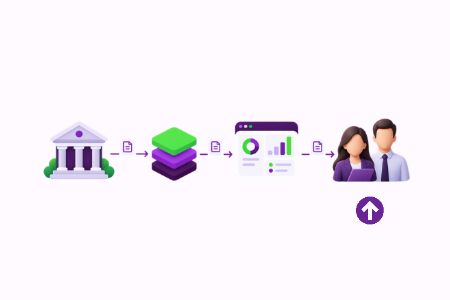
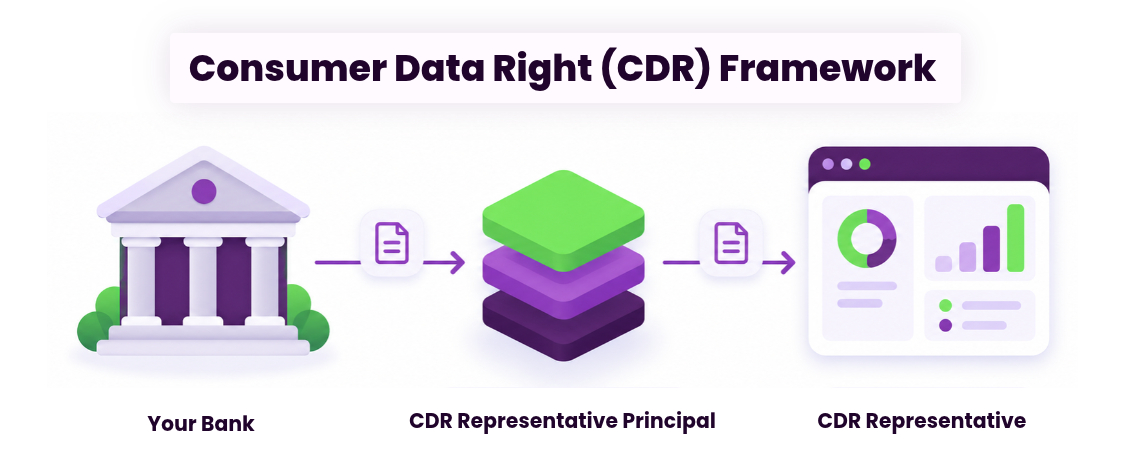
One option is through a CDR Representative arrangement. In this model, a CDR Representative provides a CDR-powered service under an arrangement with an accredited CDR Representative Principal. The CDR Representative Principal collects the data on behalf of the CDR Representative and securely passes it on so the service can be provided. We’ll explain what CDR Representatives and CDR Representative Principals are in our separate guide here.
But in essence, the data flow looks like this:
With your consent, CDR data can also be shared with certain recognised professionals or businesses, known as Trusted Advisers, to help them provide advice or a service. Trusted Advisers can include professionals such as financial advisers, mortgage brokers, accountants, lawyers and tax agents. We’ll explain Trusted Advisers in more detail, including how they apply to Moorr, in our separate Trusted Adviser guide here.
And importantly, you don’t need to hand over your banking password to the business receiving your data.
The Australian Government has a useful step-by-step explanation of the consent and data-sharing process here: See how the Consumer Data Right works
Is CDR the same as Open Banking?
Not quite.
The Consumer Data Right is designed as an economy-wide framework that can expand into different industries over time. It is currently active in banking and energy, with non-bank lending now being rolled out. Other sectors, including superannuation, insurance and telecommunications, have also been considered for future expansion.
So, while you’ll often hear CDR and Open Banking mentioned together, Open Banking is really the banking application of the broader Consumer Data Right.
You can see how the CDR is being rolled out across different industries on the Australian Government website. View the CDR rollout
For another banking perspective, CommBank also has a helpful explanation of how Open Banking relates to the Consumer Data Right. CommBank: What is Open Banking?
What banking information can be shared through CDR?
If you choose to use CDR for banking, the information available to share can include things such as:
- your name and contact details
- account names, types and balances
- account numbers and features
- interest rates, fees and discounts
- transaction information
- saved payee details
Exactly what is shared depends on the service you’re using and the consent you provide.
You can also check the ACCC’s Consumer Data Right overview here for more information about how CDR data sharing works in practice.
Who oversees the Consumer Data Right?
The Consumer Data Right was established by the Australian Government and is supported by a regulatory framework designed to protect consumers.
The system is co-regulated by the Australian Competition and Consumer Commission (ACCC) and the Office of the Australian Information Commissioner (OAIC), while Treasury leads CDR policy and development of the rules.
The ACCC has responsibilities including accreditation and compliance, while the OAIC oversees privacy protections and complaints relating to the handling of CDR data.
Learn more about who oversees the CDR
What control do I have over my data?
One of the key ideas behind CDR is that your data is yours to control.
CDR is optional. You can choose whether to use it and, depending on the service and consent arrangement, choose what information you share and how long you share it for.
CDR providers are required to clearly explain important details about your consent, including:
- what data you’ve agreed to share
- how it will be used
- who will have access to it
- how long they’ll have access
- how you can manage or withdraw your consent
The Australian Government outlines these protections in more detail on its Your Rights page here.
What about privacy and security?
The Consumer Data Right includes specific privacy protections governing how CDR data can be collected, handled, used and disclosed.
The Office of the Australian Information Commissioner (OAIC) explains that there are 13 legally binding CDR privacy safeguards designed to protect consumers.
These cover areas such as how businesses manage CDR data, how it can be used or disclosed, data quality and security, and what happens when information is no longer required. Read about the CDR privacy safeguards from the OAIC
Why was the Consumer Data Right introduced?
Data can be incredibly useful, but traditionally much of it has remained with the organisations providing the products and services we use.
The Consumer Data Right was introduced to make it easier for Australians to use their own data to their advantage.
That could mean using it to:
- compare products and services
- access services tailored to their circumstances
- support financial and cash flow management
- reduce the need to manually provide the same information again and again
At its heart, CDR is about giving consumers more choice, control and convenience over their data.
Where can I learn more?
- If you want to dig deeper, the best place to start is the official Australian Government Consumer Data Right website here.
- You can also learn more about CDR privacy protections through the OAIC, or read about the ACCC’s role in administering and enforcing the framework.
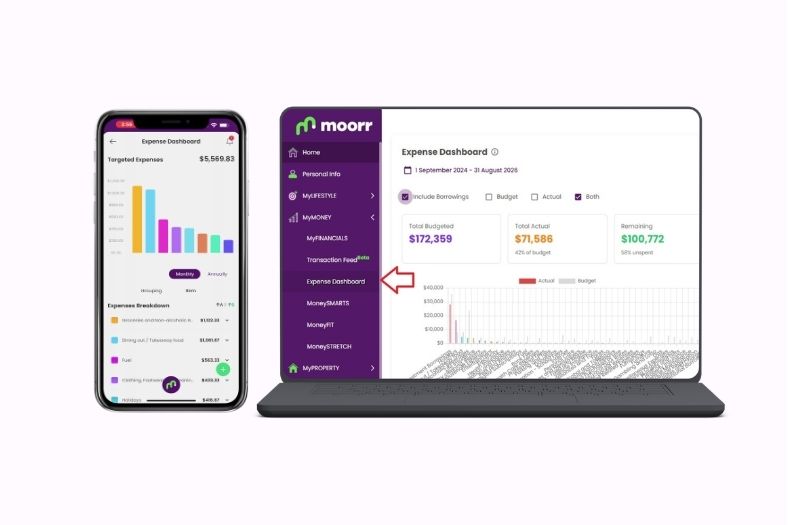
And if you’ve heard us talking about Open Banking in Moorr, now you know what sits behind it.
Open Banking uses Australia’s Consumer Data Right framework to enable secure sharing of eligible banking information with your consent.
We’ll have plenty more to share about what that means for Moorr soon. 👀