One of the most common questions we hear from Moorr users, whether they’re eyeing their first home or planning their next investment property, is a simple one:
“How much can I actually borrow?”
It makes sense. Your borrowing power sits at the start of almost every property decision. It shapes which suburbs you shortlist, which properties you inspect and when you make your next move. Yet for most people, it remains a mystery right up until they sit down with a lender or mortgage broker.
That’s why we’ve built Moorr’s free Borrowing Power Calculator, available now in Moorr, to help you understand your estimated borrowing capacity and, more importantly, what drives it.
Where to find the Borrowing Power Calculator?
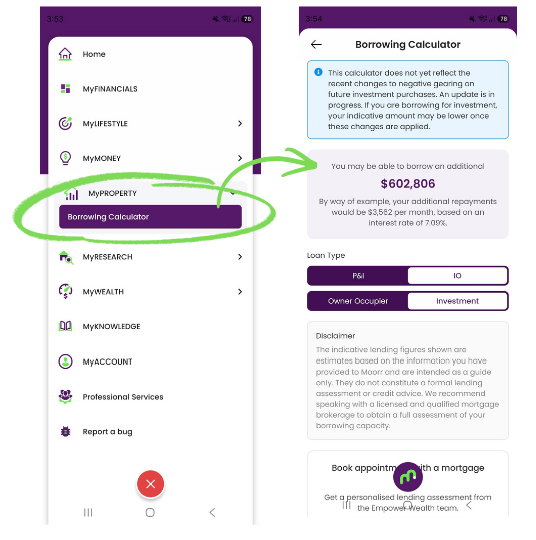
The Borrowing Power Calculator is available in MyPROPERTY on both the Moorr web app and mobile app.
Simply log in to Moorr, open the side menu and select MyPROPERTY. From there, you’ll find the Borrowing Power Calculator ready to use.
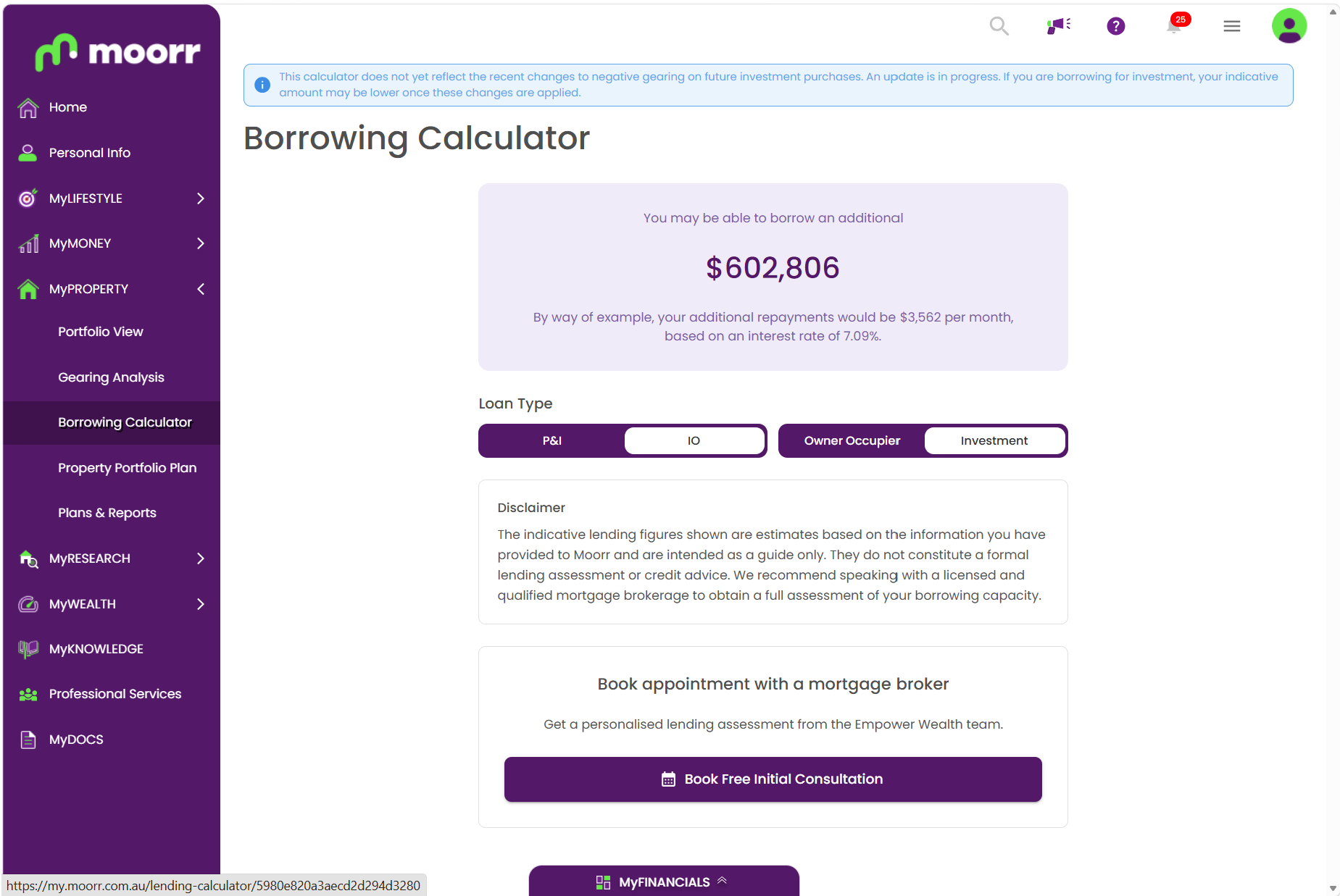
You can also tailor the estimate to the type of loan you’re considering by switching between:
- Principal and Interest (P&I) or Interest Only (IO)
- Owner-Occupier or Investment
This gives you a clearer view of how your estimated borrowing power may change depending on the loan structure and purpose.
Why we built the Borrowing Power Calculator
If you’ve ever tried a few online borrowing calculators, you’ve probably noticed they can all give you a different answer. Some feel wildly optimistic. Others seem to lowball you. And almost none of them explain how they arrived at the number.
That’s a problem, because a borrowing estimate that’s out by $100,000 isn’t harmless. It can send you inspecting properties you may not be able to finance, or rule out opportunities you could have comfortably afforded.
We wanted to give you a number you can actually plan around, one grounded in the same types of considerations lenders use when assessing your application.
Understanding your borrowing power
Here’s the thing most calculators won’t tell you: lenders don’t only care about what you earn. They care about what you can comfortably repay.
That assessment is called serviceability, and it’s less about your headline salary and more about what’s left after tax, living expenses, existing debts and other commitments are taken into account. Two households earning identical incomes can have very different borrowing capacities depending on their tax position, living expenses, existing debts and dependants.
Which is why Moorr’s Borrowing Power Calculator uses the financial information you’ve entered in MyFINANCIALS, helping you avoid entering the same details all over again and giving you an estimate based on a more complete picture of your household finances.
So rather than relying on a quick income-times-six estimate, Moorr’s Borrowing Power Calculator works through your household position step by step:
- Your income. Salary, rental income from existing properties and other income sources are brought together at the household level, with tax calculated for each borrower individually. That’s because borrowing power depends on after-tax income, not just gross income.
- Your living expenses. Lenders benchmark your declared expenses against the Household Expenditure Measure, or HEM, which reflects a minimum realistic cost of living for a household like yours. If your declared spending falls below that benchmark, the higher figure may be used. We apply similar logic because a calculator that accepts $200 a week in living costs isn’t estimating your borrowing power, it’s flattering you.
- Your existing commitments. Home loans, investment loans, car loans, personal loans and credit card limits can all reduce the surplus available to service new debt, so they’re factored into the estimate.
- A buffered assessment rate. Lenders don’t usually assess a new loan at today’s advertised interest rate alone. They add a buffer to test whether you could still make repayments if rates rise. We apply the same principle, which is why your estimate may look more conservative than some other online calculators and why it may be more useful when planning your next move.
What’s left after tax, living expenses, existing commitments and stress-tested repayments helps determine your estimated borrowing power.
A borrowing estimate you can plan with
Because the calculator lives inside Moorr, it isn’t working from a handful of rushed inputs on a standalone landing page. It can draw on the financial picture you’ve already built in the platform via MyFINANCIALS, including your income, properties, loans and spending.
That means two things: less double-handling and a more grounded estimate.
It also means your borrowing power isn’t a one-off number you scribble down and forget. You can revisit your estimate as your circumstances change and see how different decisions may affect it.
Paying down a credit card, reducing a card limit or increasing your income can all influence your borrowing capacity.
For property investors, that can help turn borrowing power from a mystery into something you can better understand and actively work on. And when you’re ready to speak with a mortgage broker or adviser, you can begin the conversation with more realistic expectations and fewer surprises.
Try Moorr’s free Borrowing Power Calculator today and get a clearer estimate of how much you may be able to borrow.
As always, check with a licensed mortgage broker, financial adviser or other qualified professional before making any lending decisions.
Disclaimer
The Borrowing Power Calculator provides an estimate only, based on the information you provide and general assumptions about interest rates, living expenses and lending criteria.
It is not a loan offer, pre-approval or an indication that any lender will approve your application. Actual borrowing capacity varies between lenders and depends on their individual credit policies and a full assessment of your circumstances.
The information provided is general in nature and does not take into account your personal objectives, financial situation or needs. Before acting on it, consider its appropriateness and seek advice from a licensed mortgage broker, financial adviser or other qualified professional.